
Get Support
+86 18055890315
Compact Material Lift for Stage and Stockroom Positioning
-
 By: ZG-Helplift
- Nov 21, 2026
- 1 Visit
ZGHELPLIFT / PRODUCT INSIGHT 04
A practical guide to raising equipment cases and light goods at the right handoff point.
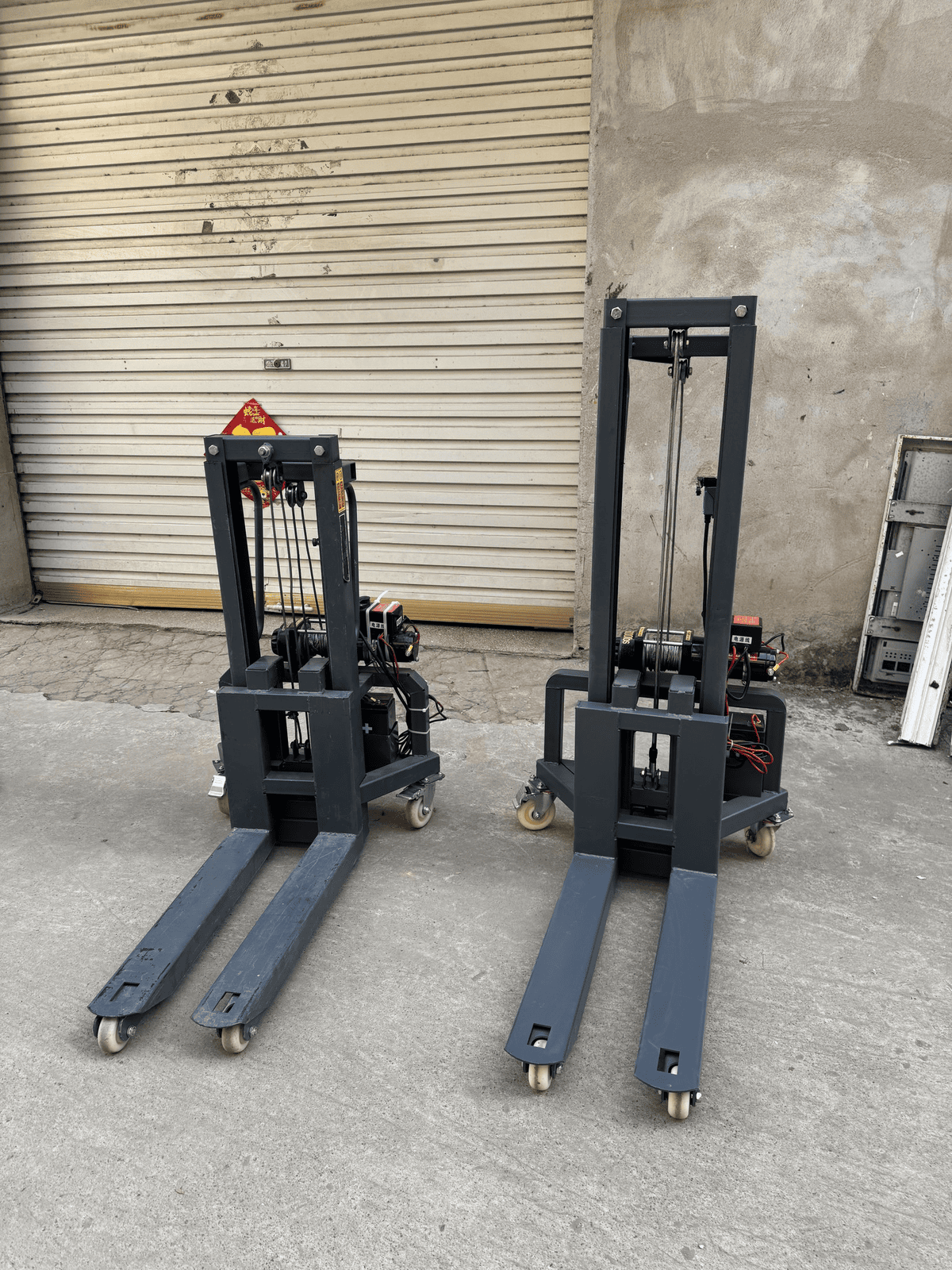
THE PRODUCT INSIGHT SERIES
Companion reading Green Compact Material Lift for Controlled Material Positioning
The last part of a stage load-in often asks more of a team than the route from the truck. A flight case has reached the venue, but the equipment still has to be brought to a raised work surface or transfer point without blocking the crew around it. A small stockroom presents the same kind of question in a different setting: where can a machine stand, what will support the load, and how high must the forks actually reach? Fuyang Zhugao Mechanical Equipment Co., Ltd. develops and supplies material-handling and installation-lift equipment for these practical tasks. Our compact material lift range is a response to a defined vertical positioning need, not a general promise that a small machine can handle every load.
The design challenge is to retain useful lift height and a clear fork arrangement while keeping the machine manageable on constrained routes. A shorter body can help at a doorway, but the load still has to remain supported at the handoff. Fork spacing can accommodate some equipment cases, but their bearing points and center of gravity vary. A battery makes electric lifting possible away from a fixed outlet; it also brings charging and maintenance decisions. These tensions require careful material and component choices, frame and cable-path attention, and an honest account of what each height configuration is rated to carry. ZGHELPLIFT's company profile describes structural refinement, component selection and inspection as part of its product approach.
China's domestic market is intensely price competitive. We cannot make that pressure disappear, and a buyer may reasonably compare quotations first. The problem is that similar headline capacities can conceal different components, material specifications, assembly details and documents. A low price does not automatically mean poor quality; a higher price does not establish quality by itself. We prefer to discuss what the quoted configuration includes and why material choice and finished-product checks matter. Our sales conversation starts with the actual case or goods, required height, route, power and destination market before narrowing the model and the documents needed for a purchase decision.
A lifting step between arrival and placement
Used for material handling and equipment positioning.The listed applications include stage audio and lighting flight cases, small warehouses, shops and exhibitions. In each setting, the job is to raise a suitably supported material load toward a receiving position. The machine is not for lifting people. It also does not make the receiving shelf, stage structure or work surface load-rated; those must be checked separately.
Think through the whole route before selecting a lift. The machine and load arrive at the work area, the forks engage the approved support points, the load rises to a useful transfer height, and the receiving team moves it onto a stable surface. A narrow aisle, a door threshold or a case with only two small feet can prevent that sequence even if the load weighs less than the published capacity.
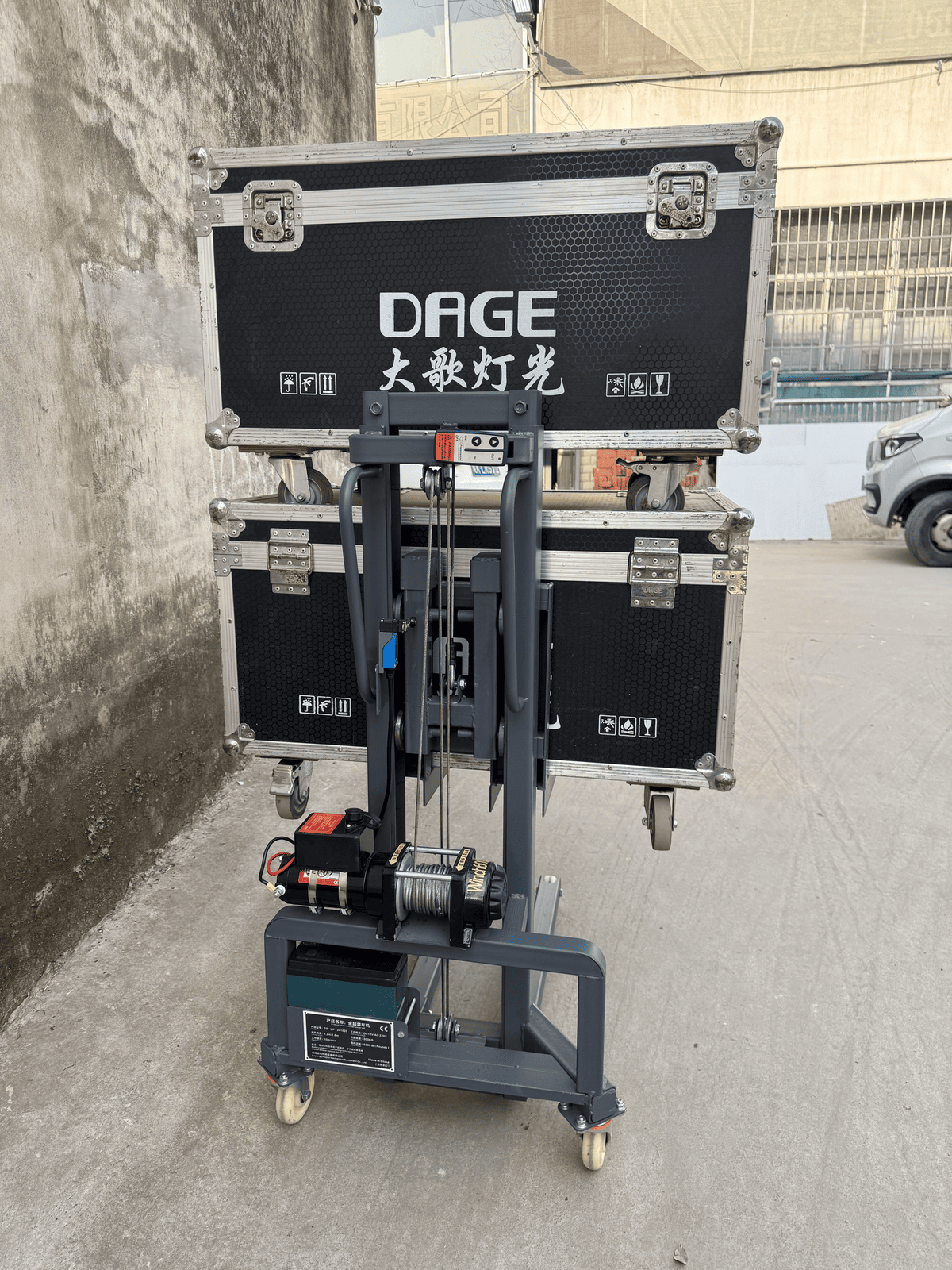
Company-supplied photograph showing equipment cases beside the lift. It illustrates the load shapes a buyer may need to assess.
The three catalog configurations
ZGHELPLIFT lists two 250 kg versions at 1.2 m and 1.6 m, followed by a 200 kg version at 2.0 m.
Model | Listed capacity | Listed lift height | Machine height | Net weight | Packed weight |
ZGHSBXZCJ120 | 250 kg | 1.2 m | 1.04 m | 55 kg | 83 kg |
ZGHSBXZCJ160 | 250 kg | 1.6 m | 1.24 m | 60 kg | 83 kg |
ZGHSBXZCJ200 | 200 kg | 2.0 m | 1.53 m | 65 kg | 90 kg |
Details that change daily use
Fork support for changing case sizes
60 cm forks and adjustable fork-arm width. Adjustable spacing can be useful when a crew handles different flight cases or cartons. It is useful only when the underside provides suitable bearing points and the load remains stable. Send drawings or clear underside photos of the largest and smallest loads. Ask for the current fork drawing and any approved attachment or restraint arrangement.
Battery information and repeat work
The listed power source is a 12 V, 20 Ah lead-acid battery, Battery level display and overload protection. These features help the team plan charging and monitor available power. They do not establish how many lifts a charge will complete. Load weight, lift travel, temperature, battery condition and use frequency all affect the working pattern. If a show, shop or exhibition has a fixed turnaround schedule, tell the supplier the lifts per shift and ask for the operating and charging guidance for the ordered machine.
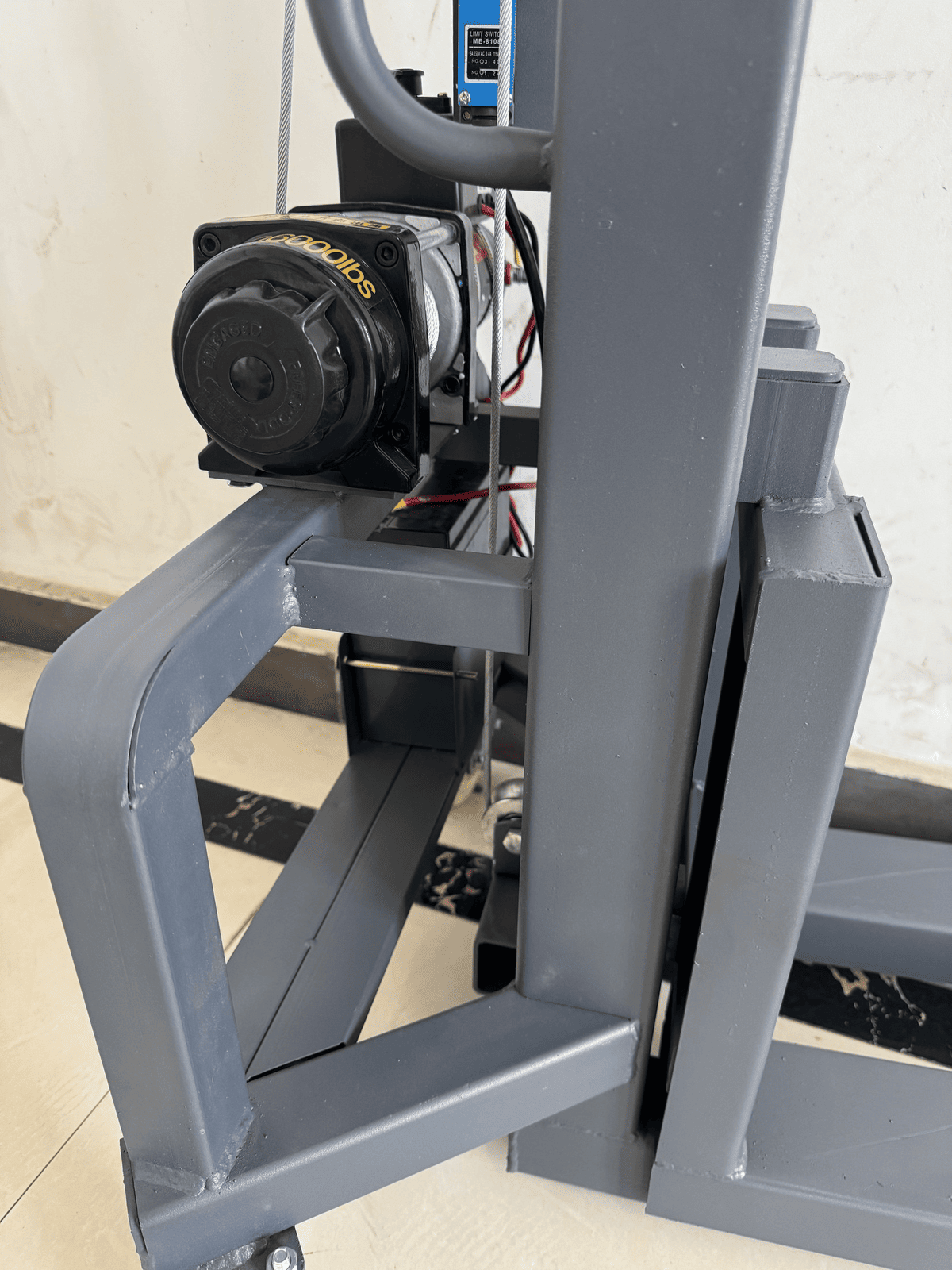
Company-supplied detail photograph. It illustrates components that deserve inspection and documentation; no motor rating is inferred from visible markings.
Three work settings to assess
Audio and lighting flight cases
Event equipment often travels in wheeled cases and meets several handoff heights between truck, venue and stage. A compact lift may help with a final vertical move once the case can be supported securely. The buyer should document the case's full weight, wheel and base geometry, lifting point, target surface and available crew space.
Small warehouse or retail stockroom
The value in a stockroom is a planned transfer without bringing in a much larger handling machine. Yet narrow aisles and shelf edges make geometry decisive. Measure the route, turning space, door openings and floor condition, then record the receiving-surface height and shelf load rating. Confirm the fork elevation, not just the mast height. Short-distance stacking in the catalog does not mean every pallet format is suitable or that the machine should travel with a raised load.
Exhibition and temporary display work
Exhibition teams often work with changing layouts and timed access. The lift may be relevant for a defined case or display component when the route, floor protection and handoff position fit. A buyer should also check venue rules, elevator limits and where the machine can be parked or charged. A compact format helps only if the crew can set the machine up at the exact work point and keep other people clear while a load is raised.
A more useful enquiry than a capacity number
Send ZGHELPLIFT a brief with the complete load weight and underside dimensions, the receiving height, route photos, floor conditions, frequency of lifting, battery-charging window and destination country. Include any attachment need, quantity, packing requirements and documents required by your importer or site. We can then discuss which of the three listed models is worth reviewing and what the latest drawing and operating instructions need to confirm.
If your work shifts from short-range positioning to a higher warehouse shelf, our Four Stage Electric Lift for Warehouse Material Positioning guide covers a different height range and working footprint. These are related selection questions, not interchangeable equipment. Link that companion guide to its live URL when publishing this article.
Hello, friend! Just tell me what your requirements are for this product
and I will help you handle your purchase needs for it.