
Get Support
+86 18055890315
Four Stage Electric Lift for Warehouse Material Positioning
-
 By: ZG-Helplift
- Nov 21, 2026
- 1 Visit
ZGHELPLIFT / PRODUCT INSIGHT 03
A buyer’s guide to high-level material placement, load support and the real working footprint.
THE PRODUCT INSIGHT SERIES
02 HVAC installation positioning / 03 High-level warehouse handling
Companion reading Mast Installation Lift for HVAC Unit Positioning
A warehouse can have usable space above the floor and still struggle to put a load there. The difficult part is often the final metre of the task: bringing a heavy item to the right aisle, supporting it correctly, raising it to the required level and transferring it without losing room for the operator. At Fuyang Zhugao Mechanical Equipment Co., Ltd., these are the questions behind our four-stage electric lift range. We supply material-handling and installation-lift equipment, and we start a product discussion with the work the buyer needs to complete, not simply the highest number in a catalog.
The problem is harder than “lift 400 kg to 6 m.” A crate, a component and a pallet can have the same mass but behave differently on two forks. A narrow route may accept a lowered mast yet leave too little space for the support base at the work point. A shelf labelled at 5 m may need a different fork height once the load's own dimensions and the transfer method are included. Addressing those details asks for careful choices about mast geometry, load support, drive components, materials and assembly, followed by a check of the actual configuration. Greater height brings reach, but it also makes stability and a well-planned handoff more important.
China's domestic equipment market puts these decisions under pressure. Buyers often see several lifts advertised with similar capacities and compare the lowest quotation first. We understand that pressure; it can be frustrating when a price line obscures differences in material specification, components, assembly and the documents supplied with a machine. A low price alone does not prove poor quality, and a higher price alone does not prove good quality. Our response is to treat material selection and quality checks as part of the configuration conversation and to explain what a buyer should verify before treating two offers as equivalent. That practical discipline, rather than an unsupported claim of superiority, is how we want engineering and sales to work together.
Our sales team therefore asks for the full load, the route, the target support height, the floor, the power supply and the destination market. Those answers shape whether a listed model is a sensible starting point and what drawings, operating instructions and conformity documents the buyer should examine. Learn more about ZGHELPLIFT and its product focus.
What the four-stage electric lift is designed to address
The catalog describes a four-stage mast, electric lifting and three height configurations for high-level material handling. Its purpose is to raise a suitably supported material load near a warehouse shelf, production position or other planned handoff point. It is not a personnel lift, and the catalog photograph is not proof that every load shape or pallet can be handled on the standard forks.
The range is most relevant when a buyer has a repeatable vertical positioning task but still needs to bring the machine into a real work area and set it up correctly. That includes some warehouse stacking, production-line feeding and workshop material placement. Whether it fits a particular site depends on the load's center of gravity and support points, the available working footprint, the target fork elevation and the transfer method.
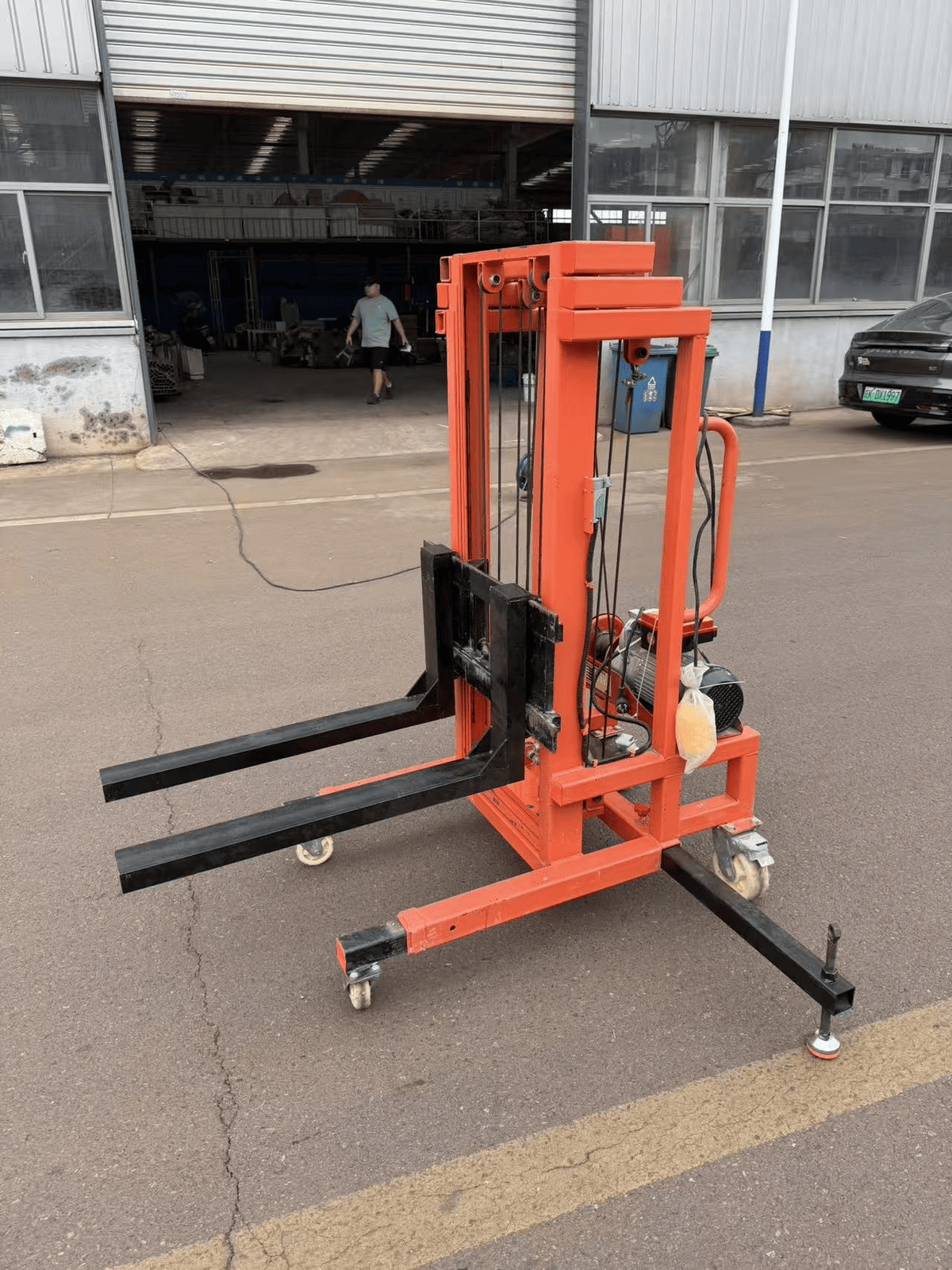
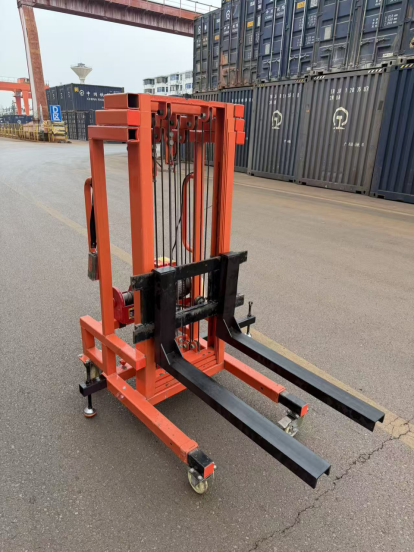
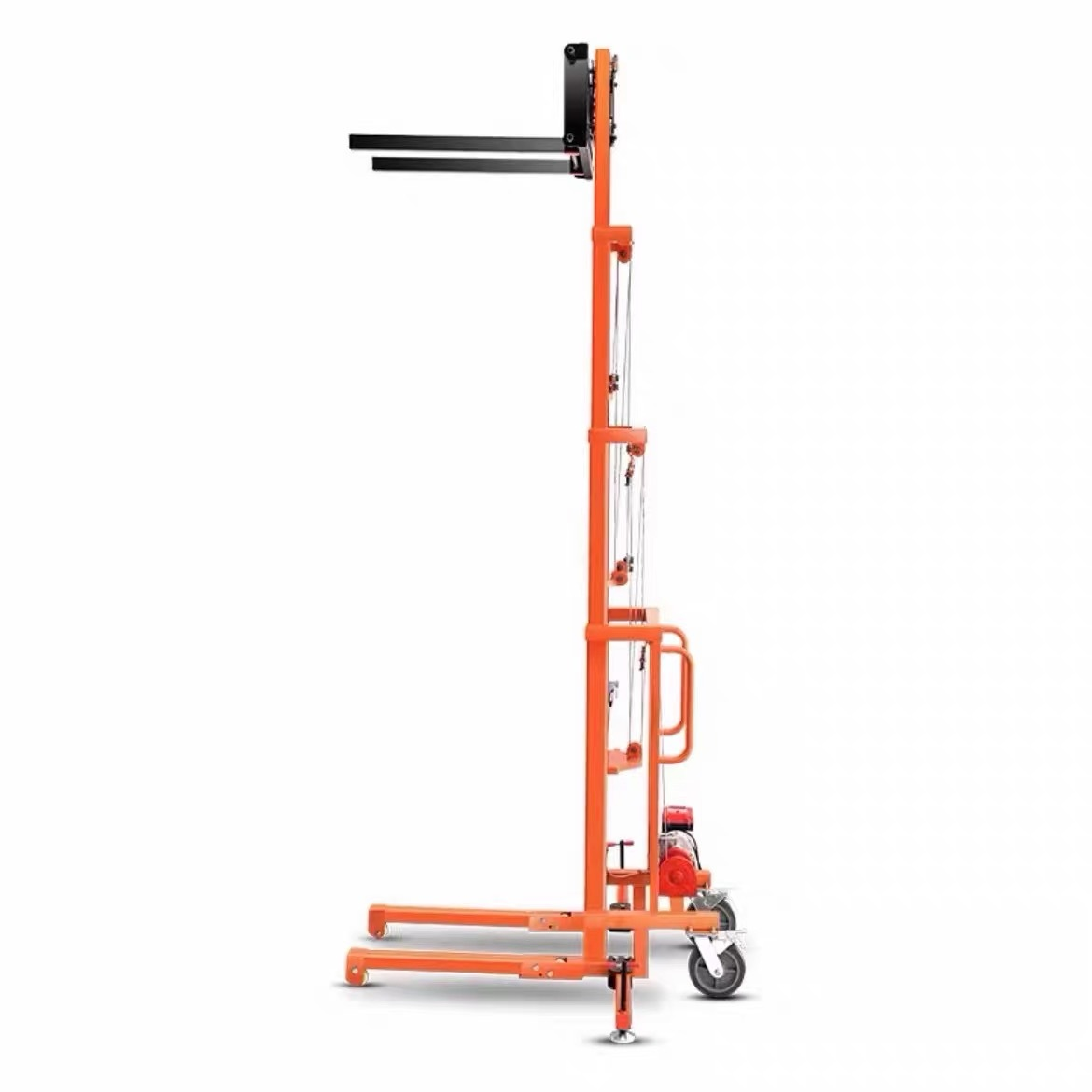
Company-supplied product photograph. The lowered configuration makes the mast, forks and support geometry visible; verify the current drawing for the ordered model.
Three listed models and what their figures mean
ZGHELPLIFT Product Catalog 3.1 lists the following configurations. Each model is separately rated at 400 kg; the 6 m height is listed for the 6 m model only. The listed machine height and net weight increase with the selected height.
Catalog model | Listed lift height | Listed capacity | Machine height | Net weight | Packed weight |
ZGddtscc400-4m | 4 m | 400 kg | 1.76 m | 165 kg | 190 kg |
ZGddtscc400-5m | 5 m | 400 kg | 1.86 m | 175 kg | 200 kg |
ZGddtscc400-6m | 6 m | 400 kg | 1.98 m | 185 kg | 210 kg |
Ask for a current drawing and load information for the exact model ordered.
The first choice is the actual support height required at transfer, not the nominal shelf label. Ask where the fork or supported load sits at maximum travel; how the load clears the shelf lip or receiving surface; and whether overhead structure limits the lift. Also measure the lowered machine against doors, lifts and turning points. A taller version may reach farther while being harder to move through a low opening. The net weights also mean unloading and moving the machine deserve their own plan; none of these figures implies one-person handling.
The catalog gives AC 220 V power, a PA1000 motor designation, 70 cm fork length and adjustable fork width of 30–60 cm. It also lists a 50 cm outrigger and 6 mm steel wire rope. The motor designation should not be read as a verified wattage. The outrigger figure does not, by itself, define the fully deployed footprint or the clearance needed around the machine. Request the current dimensional drawing and operating manual to understand both. Confirm the electrical version, frequency, plug and site supply before purchase.
How the design choices relate to the work
A telescoping mast brings height into a movable package
A four-stage mast allows the catalog to offer 4, 5 and 6 m lift-height options while listing lowered machine heights below 2 m. This can help a buyer whose destination is above normal manual handling height but whose route has limited overhead space. It does not eliminate the need to measure the complete approach. Door frames, sprinkler pipes, mezzanine beams, lighting and the load itself may all reduce usable clearance. At the final position, check the mast's vertical path as well as the support base on the floor.
The engineering tradeoff is straightforward: more reach makes the load position and mast structure more consequential. A buyer should review the current rated-load instructions and load-center limits, if specified, for the selected height. Keep the planned load within the approved support arrangement; do not infer that the full nominal rating applies to an improvised attachment or a load extending far beyond the forks.
Adjustable forks help with fit, within defined limits
The listed 30–60 cm fork-width adjustment can help align the forks with some crates, equipment bases and handling fixtures. The 70 cm fork length gives another dimension to compare with the load. Neither number confirms that an unsupported pallet, a wide cabinet or a fragile casing is suitable. The load must have appropriate bearing points and remain stable through the lift and handoff. Give the supplier the underside dimensions, center of gravity where known, complete weight and any approved lifting or support points. Ask for the fork drawing and a suitable restraint or fixture plan if the shape is unusual.
Base support matters where the lift actually operates
The machine may look compact in a photograph with the mast down. Its safe working position depends on the support arrangement specified for the ordered version. The catalog's “50 cm outrigger” line needs a drawing to establish direction, deployed footprint and any required clearance. Measure the floor area at the shelf or work station, including space for the operator, receiving surface and other traffic. Check floor level, strength and surface condition. If the base cannot be set up as instructed, a different machine or lifting method is needed, even when the capacity and height figures appear suitable.
Electric lifting changes the operator's task
Electric raising can reduce the manual effort of bringing a supported load to the target level. It does not make positioning automatic. An operator still has to choose the setup point, verify the load, keep the travel path clear and coordinate transfer at the receiving surface. A cable also has to reach the work area without crossing the lift path or a busy aisle. The catalog lists AC 220 V; confirm the supplied configuration and the destination's electrical requirements before ordering. Inspect the rope and other wear parts according to the current manual rather than relying on the catalog's 6 mm rope size as evidence of condition or service life.
Where the lift may earn its place
High-level warehouse storage
Consider a warehouse that needs to place boxed stock, components or equipment on a raised receiving position. The route may run from a packing area through a narrow aisle to a shelf bay. A four-stage lift may raise a compatible, supported load near that level, leaving the team to complete a controlled transfer onto a shelf or other rated support. Before selecting a model, record the actual receiving height, aisle width, turning clearance, load dimensions and how the load will be moved off the forks. The shelf itself must be suitable for the load. Do not assume the lift is a substitute for a forklift or that it can place every pallet type.
Production-line feeding
An assembly area may need a heavy part delivered to an elevated machine inlet or staging platform. Here the useful question is whether the forks can hold the part or its carrier at the transfer height without obstructing guards, controls or workers. The work may repeat many times per shift, so the buyer should discuss duty cycle, power access, floor route and the handoff method with the supplier. A lift that reaches the nominal height can still be unsuitable if the machine frame prevents it from approaching the inlet or if the part lacks reliable support points.
Workshop and logistics staging
In a workshop or logistics area, a lift may help bring an equipment module, packaged item or material fixture to a raised work position. The benefit is a planned vertical transfer within a defined space, not a promise to carry that load across the site while elevated. Separate the route into stages: unload and move the machine; bring the load to the setup point; establish the approved support; raise and transfer; then lower and clear the area. Check the current instructions before any movement with a load, particularly with the mast raised. If people and vehicles share the area, the operating space needs to be controlled.
A practical selection brief for buyers
Send these details with an enquiry so the discussion can move from a catalog headline to a workable configuration:
1. Load and support: complete weight, width, depth, height, center of gravity if known, underside or lifting points, packaging and any fixture that moves with it.
2. Height and handoff: target receiving-surface height, required fork elevation, shelf or platform geometry, transfer direction and overhead clearance.
3. Route and setup: photos or a plan of unloading, doors, turns, aisles, thresholds, floor condition and the available space for the fully deployed base.
4. Operation: expected lifts per shift, travel distance, who controls nearby traffic, and whether the load must be held at height during a task.
5. Power and destination: voltage, frequency, plug requirements, destination country and the product documents needed by the buyer or importer.
6. Order details: proposed model, quantity, packing, attachments, spare or wear parts, operating instructions, conformity documentation and agreed service terms.
Use the current drawing and manual to confirm usable height, load center, fork and outrigger dimensions, movement rules and operating conditions. The catalog mentions CE and warranty terms, but those lines should be checked against current model-specific documents and the terms of the actual order. A general catalog statement is not a substitute for the required destination-market paperwork.
Questions worth resolving before purchase
Is the 6 m version the best choice whenever the shelf is high? Not necessarily. Choose from the actual fork support height and transfer geometry, then check the lowered height and route. A taller machine adds reach but may not pass the same openings or fit the same work area.
Does “400 kg” mean any 400 kg load will fit? No. The rating is only one part of selection. Load shape, center of gravity, bearing points, fork dimensions, attachment and operating conditions all matter. The supplier should confirm the approved arrangement for the actual load.
Can the lift move a load across the warehouse at full height? Do not plan that from catalog copy. Review the operating manual for the supplied model and site conditions. The article discusses positioning and transfer at a prepared work point, not a general permission to travel with an elevated load.
How does this differ from a mast installation lift? Both require a load-and-site brief, but the work differs. Our companion guide to mast installation lift planning addresses the final positioning of HVAC equipment at an installation point; this four-stage range is presented for high-level material handling and staging. If the job involves an outdoor unit, wall bracket or narrow mechanical room, assess that installation task separately.
Start with the load and the receiving position
The right four-stage electric lift is the one whose specific model, approved support arrangement and working footprint fit the job. The published 4, 5 and 6 m options give a useful starting point, but selection is completed with drawings, site measurements and a clear handoff plan. Keep people off the lift and follow the supplied operating instructions for setup, inspection and use.
Send ZGHELPLIFT the load drawing or photos, complete weight, receiving height, route and work-area measurements, power details and destination country. We can review which catalog model merits a closer look and identify the current technical and order documents needed before a purchase decision.

Hello, friend! Just tell me what your requirements are for this product
and I will help you handle your purchase needs for it.