
Get Support
+86 18055890315
Mast Installation Lifts for Precise HVAC Positioning
-
 By: ZG-Helplift
- Nov 21, 2026
- 1 Visit
ZGHELPLIFT / PRODUCT INSIGHT 02
Once equipment reaches the right floor, the next challenge is planning a stable setup and bringing it to the mounting point with control.
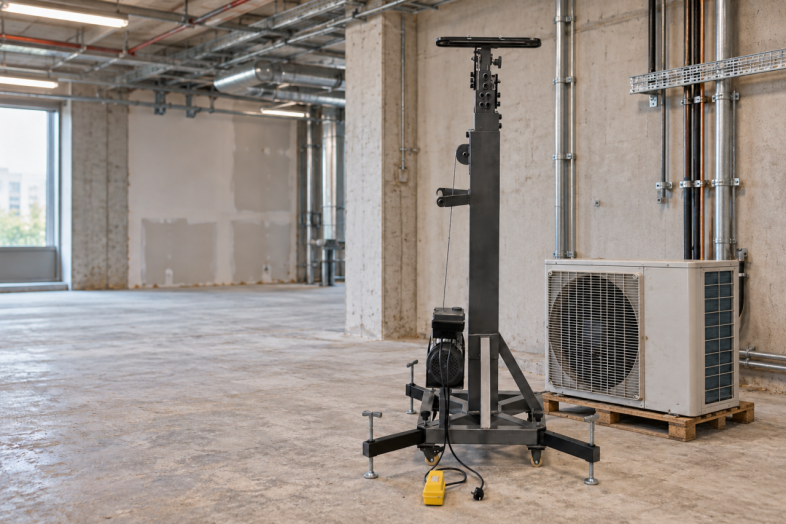 Illustrative scene • Plan the setup before raising the condenser
THE CONNECTED HANDLING ROUTE
01 Move between floors → 02 Position at installation height
Companion article Stair Climbing Hand Trucks for Demanding Deliveries
A difficult last metre
At Fuyang Zhugao Mechanical Equipment Co., Ltd., the design question is not simply how to raise a load. An installation team may have brought an air-conditioning unit through the building and still face the hardest part: holding it at the correct height while aligning it with a bracket, frame or handoff point. The unit must remain supported, the technicians need room to work, and the equipment has to fit the access route. That problem shapes how we think about installation lifts.
The R&D tradeoffs are substantial. A compact base helps a machine reach a constrained site, but the base must be set up for the intended lift. A taller mast expands the range of installation positions, yet increases the importance of load support, stability and control. Frame materials, drive components and assembly tolerances all affect the machine a buyer actually receives. In China’s intensely price-driven domestic market, those choices can be hidden behind a low headline quotation. We cannot change that pressure alone. We can examine material and component selections carefully, question whether a configuration fits its stated task and avoid treating the cheapest specification as equivalent to a well-matched one.
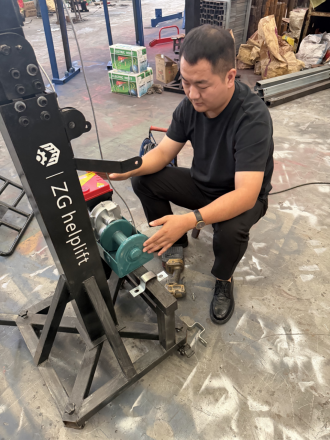
Workshop photo • Examining the mast drive and its assembly
Our sales work follows the same logic. Before discussing a model, we ask what the equipment weighs, how it will be supported, where the lift will stand and how the installation team will transfer the load into its final position. The catalog documents an installation-focused range alongside stair handling and compact material lifts. The useful innovation is often not a dramatic feature claim; it is a configuration that fits the route, mounting height and working method, backed by clear specifications and an honest discussion of its limits.
One job ends where the next begins
The stair truck addresses movement between floors; the mast lift positions a suitable load at installation height. Each stage needs its own load and handoff plan. For the first stage, read Stair Climbing Hand Trucks for Demanding Deliveries.
What the mast installation lift offers
The ZGHELPLIFT catalog lists one mast installation lift, model ZGKTSJJ500, for air-conditioning equipment work. It lists a 300 kg rated capacity, 220 V electric power with OEM support, a 75 kg net machine weight and an expanded base of 90 × 90 cm from a 50 × 50 cm compact footprint. The catalog also refers to an optional lift configuration up to 5 m and gives 1.29 m as the machine height. Those two height descriptions must not be confused: the exact lifting travel and working position should be confirmed on the current drawing for the ordered version.
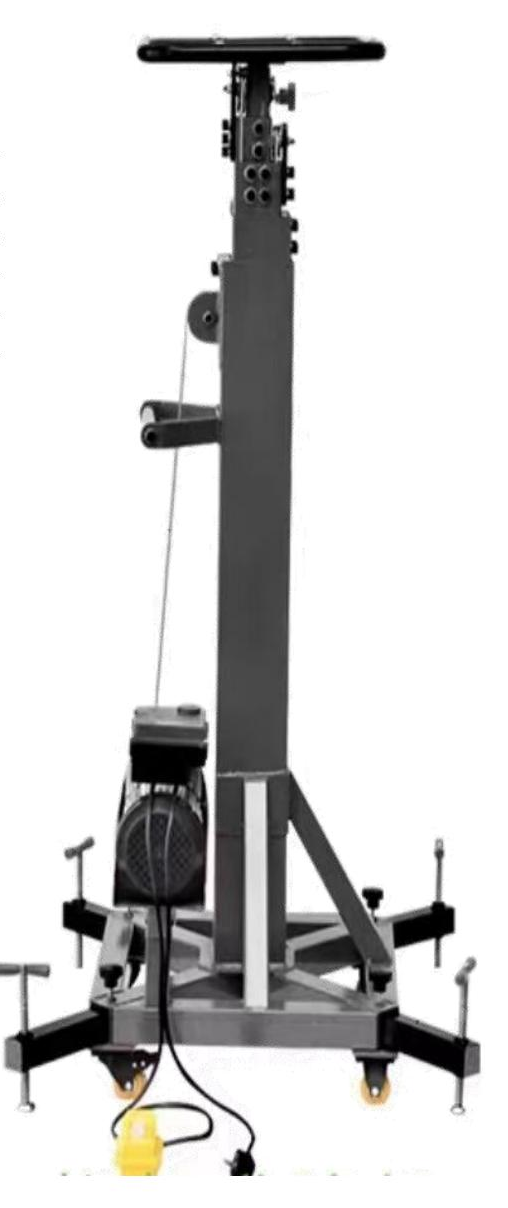
Catalog product image • ZGKTSJJ500; confirm the supplied configuration
Load support at the working height
The purpose of the mast is to bring a suitable load close to its installation position so technicians can align and fasten it without relying on prolonged manual holding. The rated capacity is a starting point, not a complete lifting plan. The unit’s footprint, center of gravity, support points and method of restraint must suit the actual load support supplied with the lift. For an unusually shaped outdoor unit or accessory, request the current load-support drawing rather than assuming that a catalog photograph shows the final attachment.
A base that needs space to work
The expandable base is useful where the machine must travel through a narrower route before setup. At the lifting position, however, the working footprint is the expanded footprint. Check that the full base can be deployed on a firm, level surface without obstructing a doorway, pedestrian route or service access. The 75 kg net weight describes the machine; it does not mean one person should lift or carry it.
Electric operation with a defined power plan
The catalog specifies 220 V power and notes OEM support. Before ordering, confirm the destination voltage and frequency, plug and cable arrangement, control method and local electrical requirements for the chosen configuration. Power availability at the work point matters as much as the nominal voltage. A practical installation plan also covers how the load will be secured, raised, held and transferred to its permanent support.
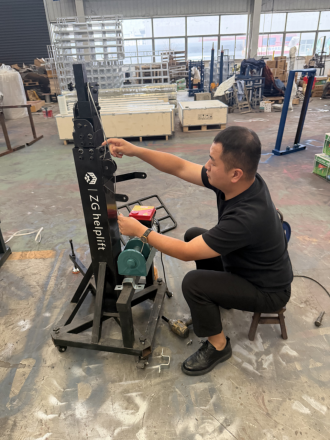
Workshop photo • Checking the mast and cable path before specifying a setup
Where the lift can fit the work
Outdoor unit installation and replacement
An outdoor condenser may arrive at the correct floor but still need to reach a wall bracket or support frame. A mast lift can help position a compatible unit while installers complete the controlled handoff. The buyer must check the unit’s full weight, dimensions and center of gravity, the mounting height, the proposed support attachment, the approach to the bracket and the available base area. The lift should not be treated as a substitute for a properly designed permanent support or for safe access to the fastening work.
Commercial storefronts and offices
A shop refurbishment or office retrofit can combine limited floor space with a narrow access route and a tight installation window. Here the compact travel footprint may help the equipment reach the work area, while the expanded base defines whether it can operate there. A site survey should include doors, turns, floor finish, ceiling clearance and the position of other trades. A clear handoff sequence can avoid repeatedly moving the load after it has been raised.
Plant rooms and maintenance tasks
In a plant room, the challenge may be placing a replacement component into a crowded area without obstructing piping or service access. The mast format can be relevant if the load can be supported on the supplied attachment and the full base can be set on suitable floor. Confirm whether the desired height is available in the ordered version and whether nearby services leave enough room for the load to travel vertically. If access or support cannot be established, use a different lifting plan.
A buyer’s five-point site brief
Describe the load. Give the complete weight, dimensions, center of gravity and any fragile or projecting parts. Explain exactly how the item can be supported and restrained.
Measure the destination. Record the installation height, bracket position, clearances above and around the unit, and the position from which technicians will fasten it.
Map the approach. Check doors, thresholds, elevators, stairs, turning space and the unloading point. If stairs are part of the journey, plan that stage separately.
Check the setup area. Confirm floor condition, level, load-bearing suitability and room for the fully expanded base. Keep the work zone clear of people who are not involved.
Confirm the order. Request the current model drawing, load-support details, operating manual, applicable conformity documents, electrical configuration, packing information and agreed service scope.
Choose the equipment around the installation
A mast installation lift is a material-positioning aid, not a platform for people and not a guarantee that any 300 kg unit can be raised at any site. Good equipment selection starts with the task sequence: get the load to the work area, establish a stable lifting position, raise it within the approved configuration and transfer it to its final support. If any step is unclear, pause the selection and review the route and attachment before the order is placed.
Share a photo or drawing of the unit, the mounting point and the intended setup area with ZGHELPLIFT. We can discuss whether ZGKTSJJ500 is a sensible starting point, what optional height configuration is needed and which documents should be checked before procurement. The aim is a lift that fits the actual installation, not merely the largest number on a page.
Continue the product insight series
Before equipment reaches the mounting point, it may have to cross a staircase. Continue with Stair Climbing Hand Trucks for Demanding Deliveries for the floor-to-floor stage and a separate checklist for the route.

Hello, friend! Just tell me what your requirements are for this product
and I will help you handle your purchase needs for it.