
Get Support
+86 18055890315
Stair Climbing Hand Trucks for Demanding Deliveries
-
 By: ZG-Helplift
- Nov 21, 2026
- 1 Visit
A practical guide to moving heavy goods when the route includes stairs, tight landings and no useful lift access.
At Fuyang Zhugao Mechanical Equipment Co., Ltd., a familiar question often starts a product discussion: how do you move a heavy, awkward load to another floor when the last part of the route is a staircase? The difficult moment is rarely the straight corridor. It is the transition onto the first step, the turn on a landing and the need to keep the load controlled while the operator can still see and move safely. Those practical constraints are why we develop and sell material handling equipment around the whole task, rather than around a single capacity figure.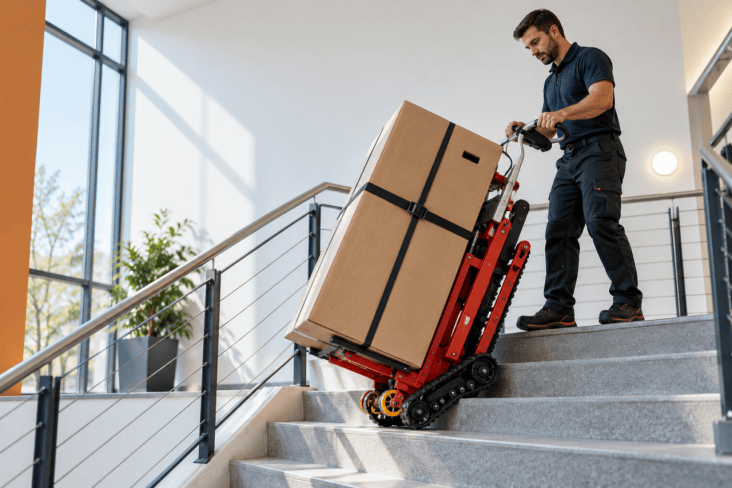
The engineering tradeoffs are demanding. A stair-climbing hand truck needs a frame and drive system suited to the rated load, stable contact with the stair surface, a useful operating position and a format that teams can transport and store. Material choice, component specification, weight and folding geometry all affect one another. In China’s highly competitive domestic market, a low quotation can be easy to compare while these less visible decisions are not. Two products with similar headline capacities may not offer the same components, finish or support. We cannot remove that price pressure from the market. Our response is to treat material selection, configuration and quality checks as decisions that deserve scrutiny, then help buyers compare the actual machine they will receive.
That approach extends from R&D to sales. Our catalog spans lifting, installation and handling equipment, and the stair-climbing range offers several load and mobility configurations. We use the buyer’s load, stairs, route and working pattern to narrow the options, then discuss the current specification, packing and documentation for the selected model. Practical innovation is often a better fit between machine and job: a folding frame where storage matters, auxiliary wheels where the level-floor route is long, or a different drive configuration where the surface demands it.
The real problem is the route between floors
A delivery team may move a boxed appliance easily across a loading bay and then reach a building with no goods lift. An installer may have to carry equipment into an upper-floor plant room. A warehouse or service team may need to move packaged goods through a narrow stairwell rather than a purpose-built freight route. Each job combines the same questions: how heavy and tall is the load, how is its mass distributed, how much space is available at each turn, and what condition are the stairs in?
A powered stair-climbing hand truck can reduce the need to manually carry the full load up or down steps. It does not remove the need for route assessment, securing the load, trained operation or a clear exclusion area. If a goods lift, ramp, hoist or revised delivery plan offers a better route, choose that route. The machine becomes valuable when stairs genuinely cannot be avoided and the selected configuration is suitable for the load and site.
What the ZGHELPLIFT range is built around
The current product catalog lists eight stair-climbing models in two rated-capacity groups: 300 kg and 400 kg. Options include crawler and off-road versions, folding designs and models with auxiliary wheels. The catalog also lists lithium battery configurations that differ by model. These are choices to match to a specific task, not features that should be added together into a fictional all-purpose machine.
Drive and contact with the stair
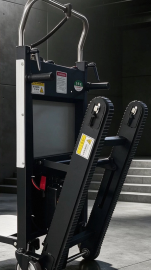
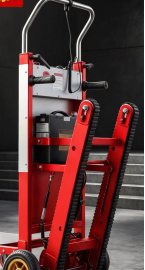
The catalog highlights a powered drive and rubber-track design. In practice, the interaction among track, stair edge, load and operator is the central question. Stair material, tread depth, nosing, slope, surface condition and the transition at the top and bottom all matter. A track is not a promise that every staircase will be suitable or undamaged. Ask for a demonstration or a route-specific review when the stairs are unusual, delicate or uneven.
A configuration for the whole journey
For some teams, the stair flight is only a short part of a longer delivery. Auxiliary-wheel variants may simplify travel across level ground; folding variants can make storage and transport easier. The catalog positions crawler models for standard stairs and off-road models for rougher surfaces. The exact meaning of those categories should be checked against the current drawing and operating instructions, especially when the route mixes surfaces or includes tight turns.
Battery planning without guesswork
The listed models use lithium battery configurations, with catalog working-time ranges of four to seven hours depending on the model. Those are planning figures, not a guaranteed number of trips. Load, stair geometry, temperature, battery condition and duty pattern affect usable time. A buyer with repeated multi-floor deliveries should describe the daily workload and ask what charging and spare-battery arrangements are available for the chosen machine.
Start with the load, then choose the variant
The table gives a useful first shortlist. It groups the eight catalog SKUs by rated capacity and chassis type; the folding and auxiliary-wheel versions are shown separately in the model codes. The current manual, drawing and order confirmation must govern the final choice.
Model group | Capacity | Format | Best question to ask |
ZG-C-A / B | 400 kg | Crawler | Is a folding frame or auxiliary wheels more useful? |
ZG-C-C / D | 300 kg | Off-road | What rough surfaces occur before or after the stairs? |
ZG-C-E / F | 300 kg | Crawler | Will storage space or level-floor travel matter more? |
ZG-C-H / I | 400 kg | Off-road | Does the full load and route suit this variant? |
Catalog capacities are model-specific. The rating alone does not establish suitability for a particular staircase, load shape or securing method.
Where it can make a difference
Appliance and furniture delivery
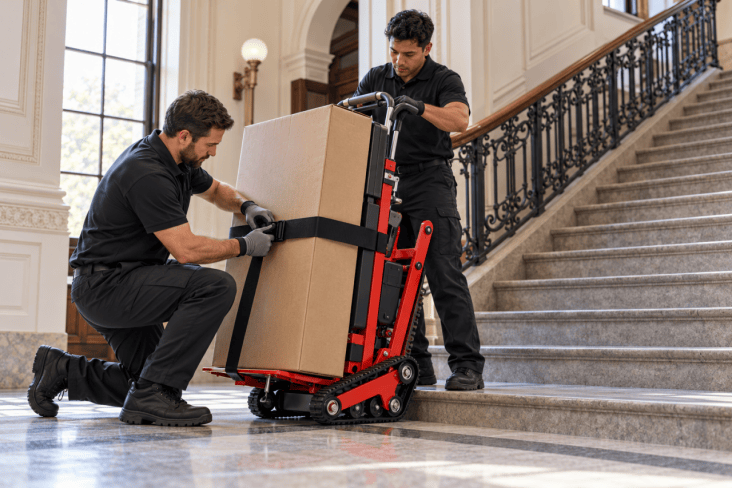
A refrigerator, cabinet or other packaged item can be bulky even when its weight is within a model’s rating. The hand truck can address the vertical part of a delivery route, while the team still needs to confirm how the item will be supported and strapped, whether its center of gravity is acceptable and whether it can turn on the landing. Fragile finishes and door clearances may be as important as load weight. The goal is a predictable handoff at the destination, not simply reaching the top step.
Installation and service equipment
Contractors moving tools or equipment into older buildings often encounter short stair flights after a long level-floor approach. Here the route may favor an auxiliary-wheel variant, provided the stair portion and load remain suitable. A pre-job survey should cover the first and last step, handrail spacing, corners, floor protection and the area where the item will be unloaded. If the equipment has an offset center of gravity or exposed components, agree on a securing method before ordering.
Stock transfers in buildings without freight access
For packaged inventory moving between floors, the benefit may be fewer manual carrying stages in a repeated task. That benefit depends on the real duty cycle and on a safe operating procedure. Measure the load as packed, count the expected trips, and verify that the battery and operator arrangement suit the shift. A 400 kg headline capacity does not make an unstable stack of boxes a suitable load.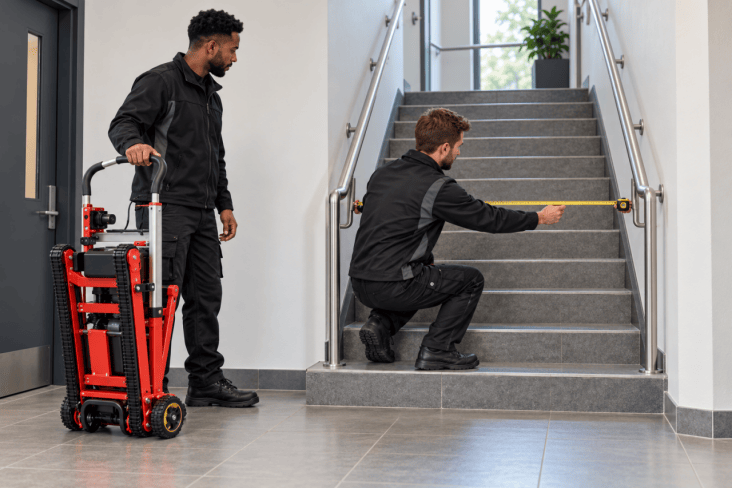
Five checks before you request a quotation
The complete load. Record the weight, dimensions and center of gravity, including packaging, straps and any accessory. Describe whether it is rigid, fragile or likely to shift.
The staircase. Provide clear width, stair rise and tread, slope, nosing, landings, turns and photos of the top and bottom transitions. Identify delicate or slippery surfaces.
The rest of the route. Note doorways, lifts, thresholds, rough ground, vehicle loading and storage space. This is where folding and auxiliary-wheel choices can matter.
The working pattern. Share the number of trips, floors, operators and charging opportunities. Ask for the selected model’s current operating guidance rather than relying on a generic battery figure.
The order details. Confirm the precise model, battery, included accessories, packing, manual, applicable conformity documents, spare parts and after-sales scope in writing.
A useful next step
Send us the load details and a short description of the stair route, ideally with photos and dimensions. ZGHELPLIFT can help compare the listed models, identify questions that need a site check and confirm the current specification for the proposed configuration. The right purchase decision begins with the route the load must actually travel.

Hello, friend! Just tell me what your requirements are for this product
and I will help you handle your purchase needs for it.