
Get Support
+86 18055890315
Stainless Steel Scissor Table for the Moments That Need a Steady Handoff
-
 By: ZG-Helplift
- Nov 21, 2026
- 1 Visit
ZGHELPLIFT / PRODUCT INSIGHT 12
A practical guide to holding light loads at the right working height.
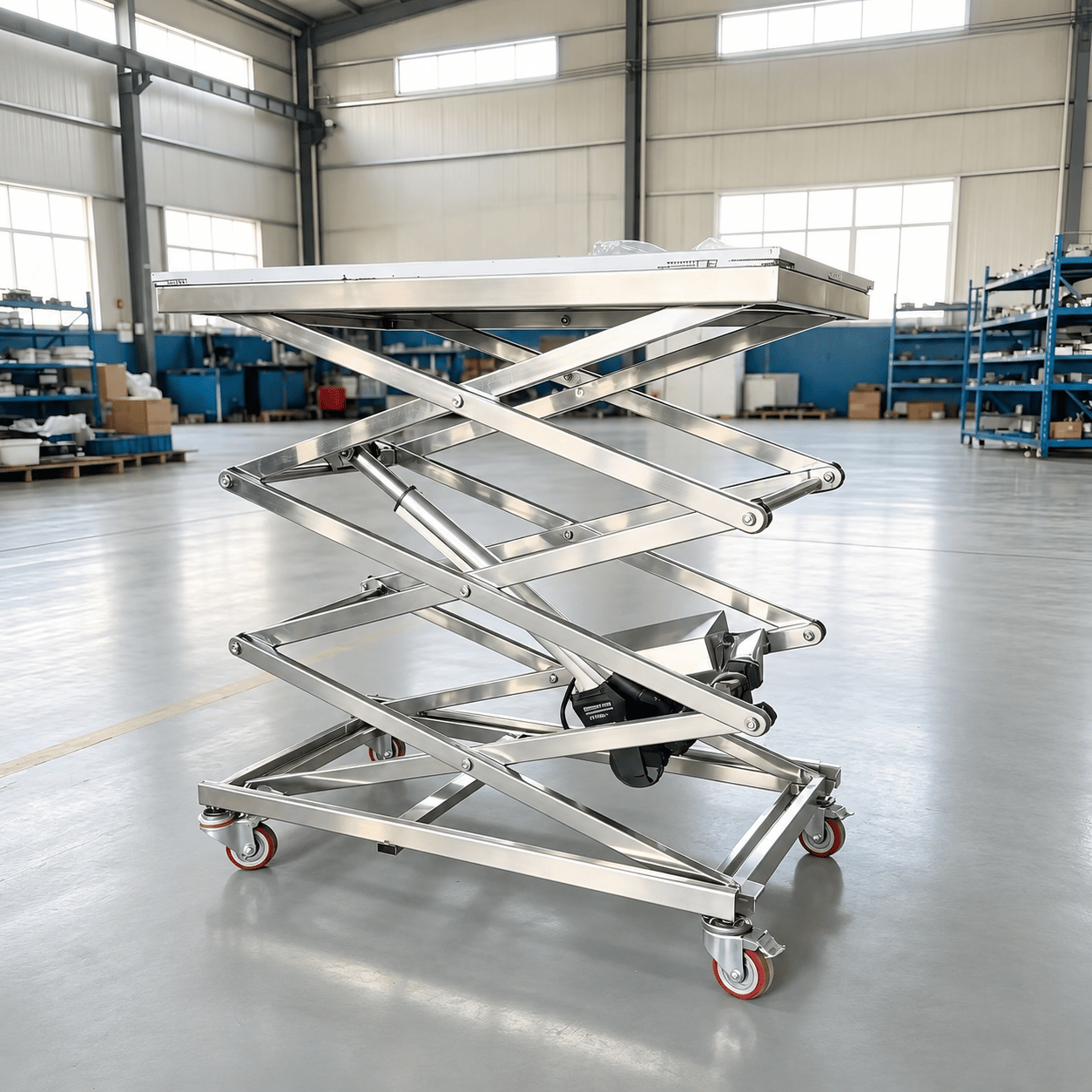
Company-supplied product image showing the raised scissor table.
THE PRODUCT INSIGHT SERIES
Companion reading Low Profile Scissor Platform for a Better Floor Level Handoff
A cabinet can reach the room on time and still be difficult to install. The team has cleared the route, marked the wall and prepared the fixings, but the unit must be held at a precise height while it is aligned. Repeatedly lifting it by hand interrupts that careful work. Fuyang Zhugao Mechanical Equipment Co., Ltd. sees this as a material-positioning problem: the last part of a job often needs steadier support more than another person carrying the load for a few seconds.
ZGHELPLIFT's range includes equipment for the transition between transport and installation. Our work starts with the object and the handoff. What bears its weight? Can the platform reach beneath it? Where will installers stand? What happens when the item is fastened or moved onto its permanent support? These questions shape a scissor table's usefulness and the product choices behind it. A compact base helps a machine reach a room, but the raised platform must remain suitable for the intended load. Stainless steel structure, joints, lifting parts, caster selection and the power arrangement all affect daily use and maintenance. Choosing them carefully is a practical form of product development, not a slogan.
In China's crowded domestic market, two machines can both be described by a platform size and lifting height while their quotations differ. We understand the attraction of a lower price, especially for a tool bought for one project. Yet that comparison should also ask about material specification, welds, moving joints, brakes, controls, inspection and included documents. A low price is not proof of inferior workmanship, just as a polished finish is not proof of fitness for a task. We would rather make the real configuration clear and help the buyer decide whether it supports the work.
From lifting a load to positioning it
The catalog presents a stainless steel scissor table for light material handling, with powered lifting and brake-equipped swivel casters. It lists one model, ZGBXGSJPT215, with a 150 kg capacity and a raised height of 2.15 m. Those figures define a starting point, but they do not tell the whole installation story. The weight must be supported over the platform as permitted by the manual, and the center of gravity must stay within the approved arrangement. A tall cabinet or uneven piece of equipment may need a different support method even below the stated capacity.
The key benefit is a more deliberate handoff. Workers can bring a suitable load to the installation area at a low level, place it on a properly supported platform, raise it toward the receiving position and make smaller alignment adjustments. That can reduce repeated manual lifting and let the crew concentrate on fit and fixing. It does not turn the table into a personnel platform, and it does not replace a temporary restraint for an item that could tip or roll. Confirm both the lifting method and the final transfer before work begins.
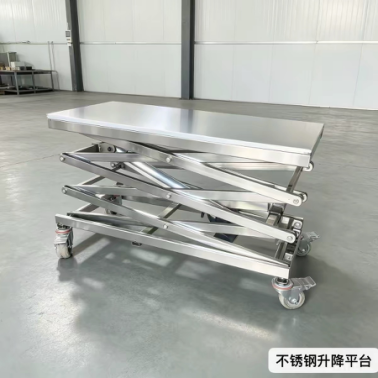
The low position matters for loading access.
Quality is visible in the less dramatic details
Stainless steel is a meaningful choice where cleanability and resistance to ordinary corrosion matter, but the grade and surface finish for a specific environment should be confirmed. A photograph cannot establish suitability for food contact, medical use or an aggressive chemical setting. The buyer should ask which parts are stainless, which are wear components and what cleaning and maintenance guidance applies. That is a more useful quality conversation than calling every shiny surface “premium.”
Mobility also has a limit. Swivel casters can help position the table within a suitable room, while brakes help hold it where lifting will occur. The floor must support the machine and load, and the route should be checked for thresholds, slopes and debris. The table should not be moved with a raised or unstable load unless the operating instructions explicitly allow it. Similarly, the catalog lists mains and battery power arrangements, but charging, cable management and the exact supplied electrical configuration should be checked before the machine is scheduled into a job.
The scissor mechanism needs room to rise without striking furniture, ceilings or projecting services. Installers should be able to reach the work without standing under the load or placing hands in moving joints. A good setup lets the table support the object while the receiving structure or fixing carries it next. This sequence is what makes the tool useful: the lift handles a defined vertical move, and the crew can spend its attention on alignment and secure transfer.
Work settings that reveal the real requirement
Hanging cabinets and interior fit-out
A cabinet may need to be presented to a wall at a consistent height while the installer checks level and fastening points. Measure the complete cabinet, including doors or temporary bracing, and identify where it can bear on the table. The receiving wall and brackets must be ready to take the load. If the cabinet overhangs significantly or its center of gravity shifts as doors open, request a support review rather than assuming that nominal capacity is enough.
Commercial furniture and display installation
Fit-out crews often work among finished floors and narrow passageways. The table's compact rolling form can be useful when the route and floor protection are planned. Confirm door width, turning space, platform clearance and where the table will be parked after the transfer. A successful move is one in which the team does not have to keep lowering and lifting the same item to find a workable position.
Equipment maintenance
A technician may need to hold a removable unit near its mounting level while connections are aligned. The table can support a suitable part during that controlled handoff. Record the part's weight, dimensions, fragile faces and lifting points; confirm that the machine can stand close enough without obstructing access. The table should not be treated as a substitute for a fixture that the maintenance procedure specifically requires.
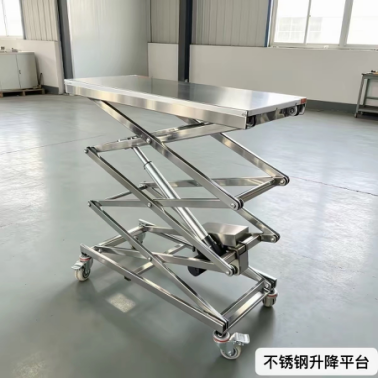
Company-supplied image showing the raised scissor structure.
Start the discussion with the object to be held
Send ZGHELPLIFT the load's complete weight, underside dimensions, center of gravity if known, target support height, room and doorway dimensions, floor condition, power availability, frequency of lifting and destination country. A photo of the object and its final support is especially helpful. We can then discuss the current model, platform fit, operating instructions and the documents needed for a purchase decision.
For a related job with a different platform size and rated load, read our Low-Profile Scissor Platform for Material Handoffs guide once its live URL is available. The useful comparison is the load and transfer method, not the finish alone.
Hello, friend! Just tell me what your requirements are for this product
and I will help you handle your purchase needs for it.