
Get Support
+86 18055890315
Low Profile Scissor Platform for a Better Floor-Level Handoff
-
 By: ZG-Helplift
- Nov 21, 2026
- 1 Visit
ZGHELPLIFT / PRODUCT INSIGHT 13
A floor-to-work-height guide for material positioning.
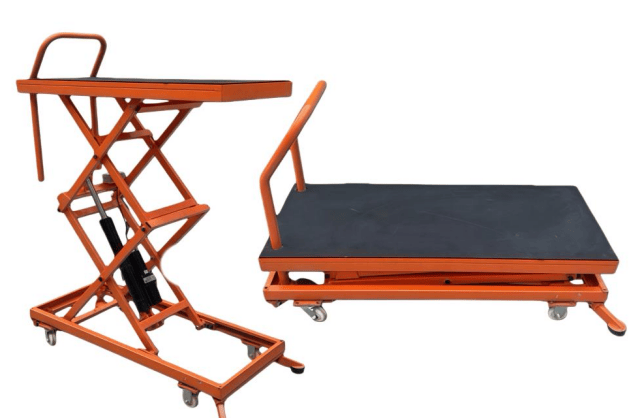
Catalog product views of raised and lowered positions. Confirm the current platform and load-support drawing before specifying a job.
THE PRODUCT INSIGHT SERIES
Companion reading Stainless Steel Scissor Table for the Moments That Need a Steady Handoff
The material is already inside the building. It has crossed the loading bay and reached the renovation area, but it is still sitting near floor level while the next task happens above it. A crew has to bring a panel, packed unit or fixture to a workable height, hold it steady and transfer it to its permanent support. That last vertical move can interrupt a well-planned job. Fuyang Zhugao Mechanical Equipment Co., Ltd. sees a low profile scissor platform as a response to this handoff: bring a suitable load onto a low deck, raise it in a controlled way and give the receiving team a clear chance to complete the transfer.
ZGHELPLIFT works with lifting and installation equipment across several stages of a job. The company discussion starts with the point where work slows down. Can the load be brought onto the platform without another awkward lift? Will the machine fit through the route and stand close enough to the receiving point? What support holds the load while it rises? These questions direct design and selection. A low collapsed height can help loading access, while the scissor structure, platform, frame and electrical system must remain suitable at the raised position. Material thickness, joints, wheels and inspection access affect durability and service as much as the headline capacity.
Domestic price competition in China can make this careful work hard to see. A low quotation and a high quotation may both describe a scissor lift, yet differ in material, component, assembly, inspection and included documents. We understand the need to control cost; we also know that price alone does not prove either quality or suitability. Our approach is to check what will actually be supplied and ask the buyer for the load, route, working position and destination market before treating a catalog model as the answer. A scenario of a technology CEO developing new products
A low starting point changes the sequence
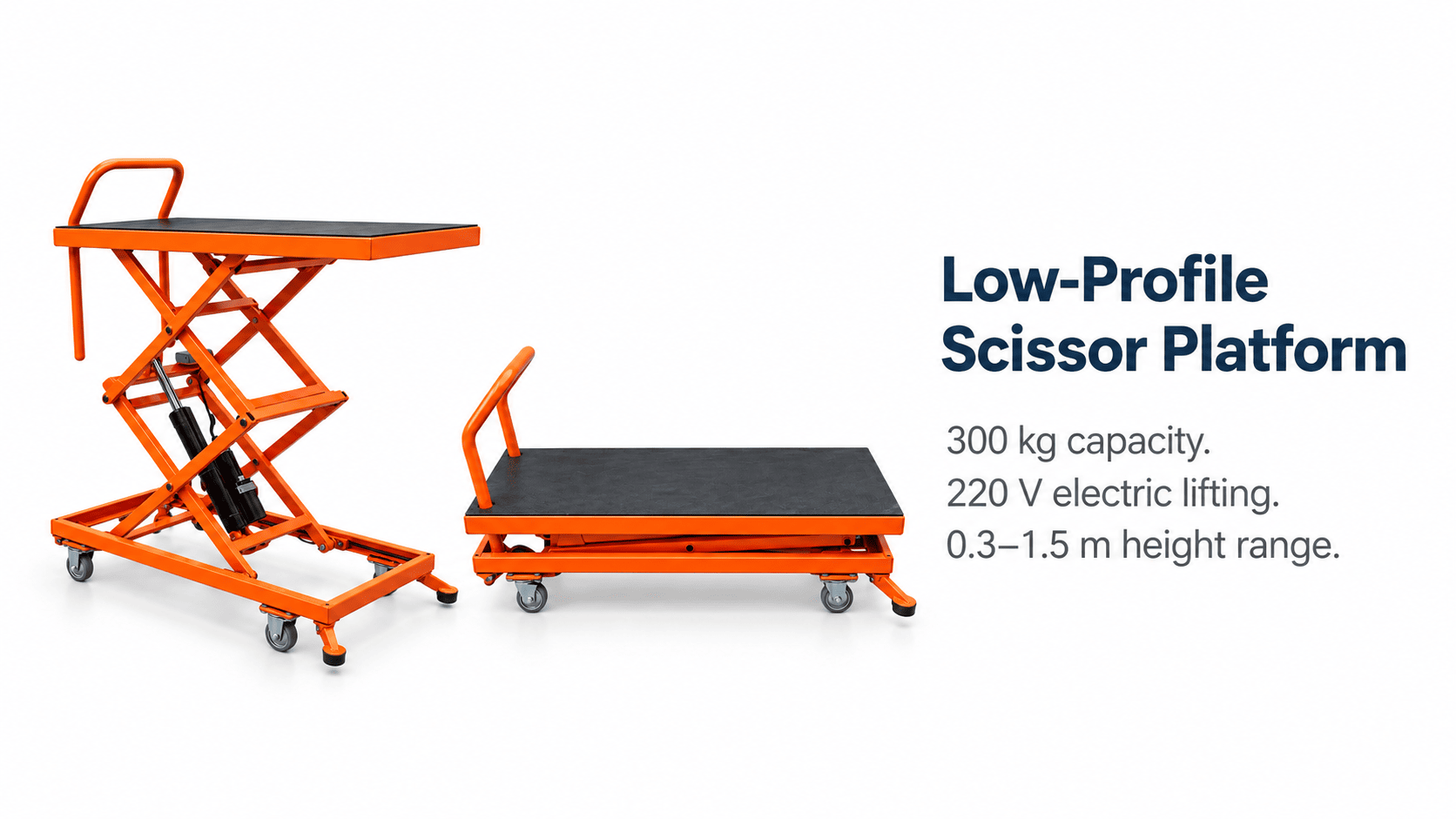
The catalog lists a single low-profile model, ZGDDMD150, with a platform that lowers to about 0.3 m and rises to a listed 1.5 m. It is an electrically lifted material platform with a 300 kg catalog rating. These facts matter because they frame the handoff, not because the highest number is automatically the right working height. The load still has to reach the deck, sit on approved support points and remain stable while the platform moves. The receiving surface must be ready to take the load at the other end.
Imagine a large fixture resting on a small transport trolley. If the fixture's underside cannot sit securely on the platform, a low deck does not solve the transfer. The team may need a fixture, a pallet arrangement or another machine. If the load is balanced and supported appropriately, the low entry can reduce one repeated manual lift. The crew can then use the platform for the defined vertical movement and devote its attention to alignment and fastening. That is a practical efficiency improvement in the work sequence, not a claimed percentage of time saved.
The platform must fit both ends of the move
The catalog gives a rectangular work surface. Before ordering, measure the complete load, including packaging, projecting feet, handles and any temporary restraint. The platform length and width should be checked against the load's real bearing points, not merely its outside dimensions. A long item can overhang a deck while its center of gravity sits far from the intended support. A compact item can also be unstable if its base is narrow. Ask for the current drawing and approved load distribution rather than assuming the rating applies to every shape.
The approach route matters as much as platform size. Record door widths, thresholds, ramps, turning space, floor loading and where the electrical cable will run. The catalog mentions movement, but a mobile base should not be read as permission to travel with a raised load. Confirm wheel, brake and movement rules in the current manual. Before lifting, the crew should be able to stand clear of the scissor mechanism and keep others out of the working zone.
The raised position has its own constraints. Ceiling beams, wall projections and existing services can prevent the platform from standing where the transfer is needed. If the installation point is beyond the platform's usable range or requires a different support shape, choose another method. The catalog's application list includes interior decoration and installation work, but it does not establish that the deck is approved to carry people. A buyer planning personnel use must request explicit model-specific authorization and applicable local documentation.
Where a defined material lift can help
Fit-out components in a commercial space
Panels, display structures or boxed fittings may arrive close to the floor and need to meet a bench or mounting position. The scissor platform can be considered when the load's base is compatible and the machine can stand near the receiving point. Plan the sequence from transport device to platform and from platform to final support. The less often the crew has to put the item down to reset its grip, the more predictable the installation becomes.
Building-service equipment
A packaged mechanical or electrical component may need to be brought alongside a support frame for connection or fastening. The platform can help position a suitable part while the receiving structure is prepared. It should not be relied upon as the only restraint for a top-heavy unit or as a substitute for a manufacturer's installation fixture. Record the center of gravity, connection side, access required for tools and final support height.
Maintenance and repair
Maintenance teams sometimes remove a heavy component and need a stable place to lower it before transport. The same low starting point that helps loading can help control a reverse handoff. Confirm that the platform can approach the machine safely, that no one works beneath an unsupported load and that the removed component fits the approved support area. A planned transfer often prevents extra handling later in the job.
Give the sales team a complete handoff picture
Send ZGHELPLIFT the load's full weight, length, width, underside and center of gravity if known; the initial and final support heights; route photos; floor and doorway details; available power; expected number of lifts; and destination country. A photo of both the starting and receiving position helps us discuss whether this platform is the right tool. Ask for the current model drawing, load distribution rules, movement and brake instructions, operating manual and applicable documents before ordering.
Our Stainless Steel Scissor Table for the Moments That Need a Steady Handoff guide explores a related light-load positioning task with a different platform and material construction. The comparison should begin with the object and the work area. Add the live companion URL when the guides are published.
Hello, friend! Just tell me what your requirements are for this product
and I will help you handle your purchase needs for it.