
Get Support
+86 18055890315
Truck Mounted Forklift for Delivery Site Material Handling
-
 By: ZG-Helplift
- Nov 21, 2026
- 1 Visit
ZGHELPLIFT / PRODUCT INSIGHT 06
A buyer's guide to the load, the delivery site and the vehicle that carries the machine.
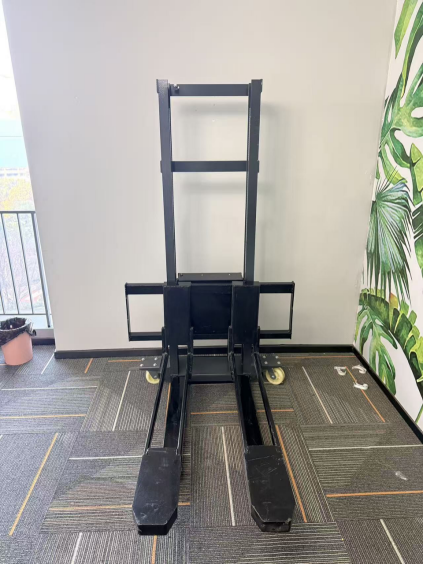
Company supplied product image • Verify the ordered configuration
THE PRODUCT INSIGHT SERIES
Companion reading Four Stage Electric Lift for Warehouse Material Positioning
The delivery vehicle has arrived, but the receiving site has no forklift waiting. A driver may face a palletized component, building material or farm supply that cannot simply be carried by hand. That gap between transport and the final unloading point is why Fuyang Zhugao Mechanical Equipment Co., Ltd. offers a truck-mounted forklift family. The important buying question is broader than “Can it lift one tonne?” It is whether the specific vehicle, load, ground, route and unloading height can work together as a controlled handling plan.
The job begins before the truck stops
A truck-mounted forklift is useful only if it can be carried, secured, deployed and used in the planned delivery sequence. The catalog describes a machine carried with a vehicle, electric lifting, manual travel and wireless remote control. Those words do not define a universal mounting bracket, vehicle payload allowance or safe deployment method.
Walk through the order of work. How is the machine loaded onto or carried by the vehicle? Where can the vehicle park? How will the forklift reach the load and then the receiving surface? What is the ground like between those points? The route may include gravel, a ramp, a threshold or pedestrian traffic. A 1,000 kg headline rating says nothing by itself about a sloped surface, a long load with an offset center of gravity or a vehicle whose mounting position is not approved.
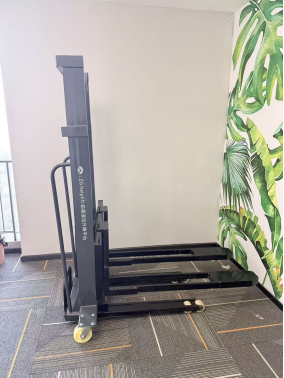
Company-supplied product view.
Two catalog models
ZGHELPLIFT lists two models. Both are rated at 1,000 kg, with different listed lift heights. Both are listed at 225 kg net and 252 kg packed. 120 cm fork length and a 1,500 W motor.
Model | Listed capacity | Listed lift height | Net weight | Packed weight |
ZGSCCC130 | 1,000 kg | 1.3 m | 225 kg | 252 kg |
ZGSCCC160 | 1,000 kg | 1.6 m | 225 kg | 252 kg |
The catalog lists machine dimensions of 180 × 85 × 200 cm for ZGSCCC130 and 210 × 85 × 200 cm for ZGSCCC160, folded or transport state, and clearance. Both models are listed in a 237 × 105 × 54 cm wooden case.Packaging dimensions provide references for freight planning.
The power line reads “48 V 6 A Battery (OEM Supported)”.
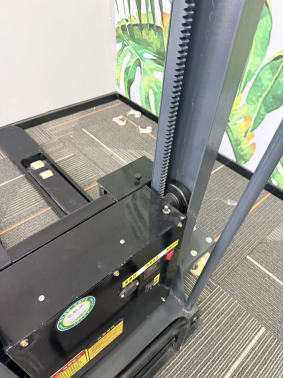
Company-supplied detail photograph.
Three delivery settings to test against the machine
Building materials. A distributor may deliver bulky components to a site without a loading dock. The forklift can be considered if the load's pallet or base engages the forks correctly, the vehicle can carry and deploy it, and the route is within the operating limits. Check where the material can be set down and whether a construction crew has kept the unloading zone free. A long bundle may have a center of gravity unlike a compact pallet of the same mass.
Farm and rural deliveries. Supplies may need to leave a vehicle on firm ground before being moved toward storage. The ground often decides the plan. Photograph the parking and travel surfaces, note slopes or soft areas and define the receiving height. A manual-travel machine should not be assumed to perform like a powered all-terrain forklift. If the site lacks a suitable surface, choose another unloading method.
Logistics distribution. Repeated stops create pressure for quick setup. That makes the transport mount, deployment steps, charge state, load types and operator training important. Ask how many lifts are expected per route and whether the battery and inspection schedule fit that pattern. The equipment must be secured during travel and the unloading method must be repeatable at each destination; a single successful demonstration at one site cannot establish fitness for the whole route.
Build a complete delivery brief
Send ZGHELPLIFT the truck details, proposed carry or mounting location, payload allowance, complete load weights and dimensions, pallet or support geometry, bed and receiving heights, site photos, ground conditions, expected stops and lifts, battery and charging requirements, and destination country.
For warehouse work after the material has already reached a suitable floor, the Four Stage Electric Lift for Warehouse Material Positioning guide addresses a different stage: raising compatible loads toward higher receiving points. Treat the two product families as related handling decisions.
Hello, friend! Just tell me what your requirements are for this product
and I will help you handle your purchase needs for it.