
Get Support
+86 18055890315
Foldable Material Lift for Constrained Storage and Work Areas
-
 By: ZG-Helplift
- Nov 21, 2026
- 1 Visit
ZGHELPLIFT / PRODUCT INSIGHT 07
Selection starts with the storage space, the load and the handoff—not the fold alone.
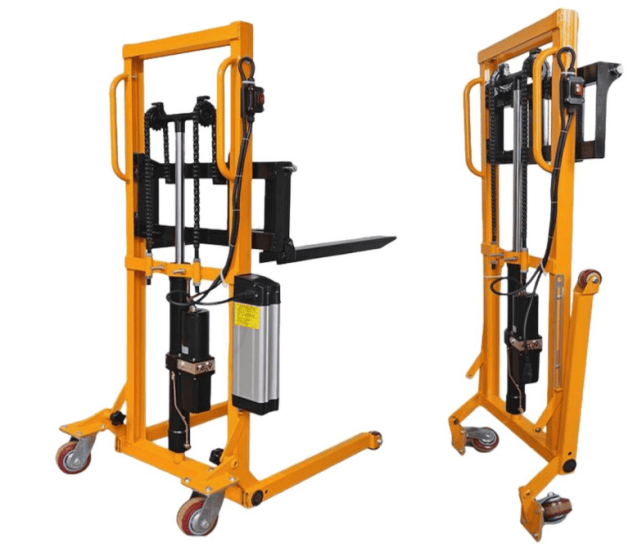
Company supplied product image
THE PRODUCT INSIGHT SERIES
Companion reading Compact Material Lift for Stage and Stockroom Positioning
Storage can be the reason a useful lift never reaches a job. A service team may need a machine that fits a vehicle between calls; a temporary venue may have no room to keep an upright lift after the work is done. But a thin folded profile solves only the storage part of the problem. At the work point, the lift must open correctly, support a real material load and reach a real receiving height. That tension guides Fuyang Zhugao Mechanical Equipment Co., Ltd. when discussing its foldable material lift range with buyers.
A folding frame introduces more questions than a fixed frame. The hinge and locking arrangement have to be understood in the operating position, not judged from folded dimensions. Fork geometry must meet the load's bearing points, while low fork clearance must still suit the floor and packaging. Electric and manual configurations change the operator's work, charging needs and service parts. These are the practical development and quality questions behind material selection, component choice, assembly and inspection.
China's domestic market often rewards the smallest price visible in a search result. We understand why buyers begin there, and we also know how frustrating it is when a quote cannot show what steel, wheels, drive parts, locking hardware, packing or documentation it includes. A low price is not evidence that a product will fail, and a higher price is not a test report. Our response is to discuss the specified materials and configuration carefully and ask the buyer to compare complete offers. Our sales team starts with the route, storage space, load and use frequency, then narrows the model and requests the necessary drawings. See ZGHELPLIFT's company profile for its wider product focus.
Two states of one machine need two measurements
The catalog describes five folding-lift models: three lithium-battery versions and two manual versions. It lists a folded thickness of about 200 mm across the family. That is useful for storage planning, but thickness alone does not establish whether a machine fits a van, passes a stairwell or can be stood safely against a wall. The full folded length and width, weight, securing points and storage orientation must be checked for the selected model.
At the work point, the machine is no longer folded. Ask how the frame is opened and locked, how the forks approach the load, what floor area the open machine occupies and where the operator stands. The support base and any stabilizing procedure matter more to a lift at work than a slim storage photo. The catalog's broad machine-dimension line needs a model-specific drawing before it is used for clearance planning.
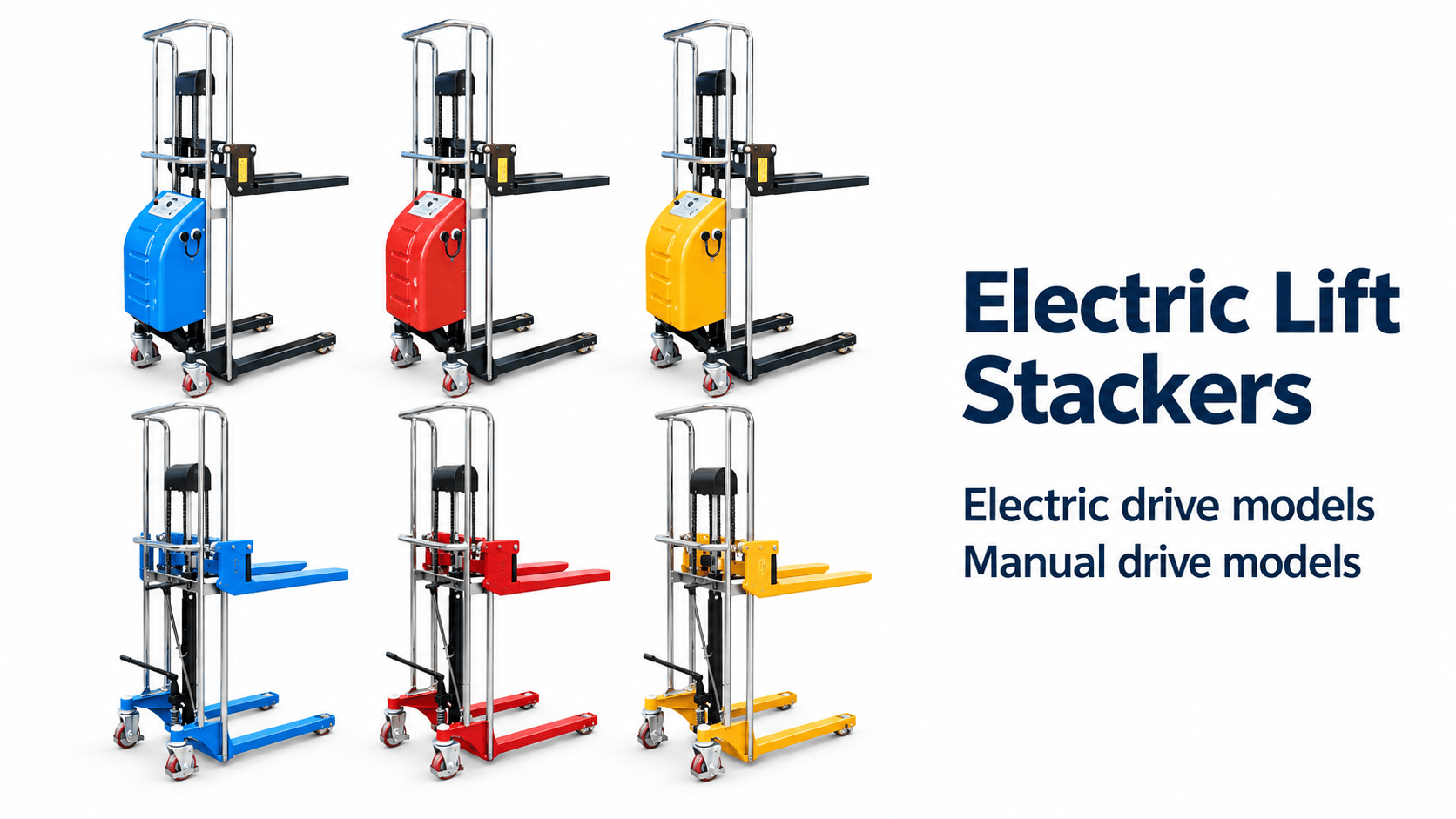
Five catalogs
The height and capacity figures vary by model. The 1.4 m electric model is rated at 150 kg; the other four listed models are 200 kg.
Model | Listed drive | Capacity | Lift height | Net weight | Packed weight |
ZGddzdcc200-1.0m | Lithium battery | 200 kg | 1.0 m | 50 kg | 75 kg |
ZGddzdcc200-1.2m | Lithium battery | 200 kg | 1.2 m | 53 kg | 78 kg |
ZGddzdcc200-1.4m | Lithium battery | 150 kg | 1.4 m | 56 kg | 81 kg |
ZGsdzds200-0.9m | Manual | 200 kg | 0.9 m | 45 kg | 78 kg |
ZGsdzds200-1.2m | Manual | 200 kg | 1.2 m | 53 kg | 68 kg |
The listed folded dimensions also differ. The three electric models are 1550 × 620 × 200 mm, 1760 × 620 × 200 mm and 1960 × 620 × 200 mm in order of increasing lift height. The two manual versions are listed at 1450 × 620 × 200 mm and 1750 × 620 × 200 mm. These are catalog values, not guaranteed vehicle-fit measurements. Check protrusions, packaging, handling clearance and how the equipment is restrained in transport. Compare the exact SKU rather than assuming two models with the same lift height have the same folded length or packed weight.
The technical questions behind a compact fold
Fork approach and support
The catalog lists 550 mm forks on the electric versions and 530 mm forks on the manual versions, with 85 mm fork ground clearance and adjustable width. obtain a drawing for the chosen machine. Low-position forks can make some floor-level loads easier to approach, but a pallet, case or fixture still needs an underside that the forks can support. Measure the load, including packaging, and identify its center of gravity and bearing points.
Electric or manual operation
The electric models are listed with a lithium battery. Ask the supplier to describe the exact lifting and travel method on each model before estimating operator effort or duty cycle. Repeated lifts in a busy workday may favor one operating arrangement, while a rarely used lift may raise different questions about storage and battery care. Neither choice should be made from price alone.
Open-state locking and inspection
The fold is useful only if the machine is correctly deployed for work. Request the opening, locking and inspection instructions. Look for wear points in the current manual, not merely in a photograph of the hinge. Record how the lift will be secured between jobs and how the fork assembly will be protected. The published 45–56 kg net weights are not evidence that one person can carry the equipment into a vehicle or up steps; plan a suitable loading method.
Where a foldable lift may be worth considering
Mobile service and installation support
A team that visits different sites may need to transport a lift beside tools and materials. The folded length, weight and securing method determine whether that is practical. At the destination, the team still needs a level work area and a compatible load. Supply vehicle dimensions, unloading method, door and floor measurements, load geometry and target transfer height. This is a possible selection scenario, not a claim that every model fits every service vehicle.
Temporary exhibitions and events
Temporary work often has a small storage allocation and a short setup window. A foldable lift may help raise a defined material item to a handoff height, then be stored in less space after the shift. The buyer should check the venue's route, floor protection, loading time and rules for powered equipment. The fold does not remove the need for a clear operating zone or a separate plan for a load that cannot be supported on the standard forks.
Stockrooms with limited equipment space
A small business may have occasional raised-positioning work but no permanent parking place for an upright lift. Here storage size can genuinely influence selection. Measure both the storage location and the deployed work position, including shelf access and how the load will leave the forks. A lift that fits in a cupboard but cannot open beside the shelf will not solve the task. If frequent lifting or heavier loads are expected, a non-folding model may deserve comparison.
Questions that prevent a poor fit
Does 200 mm folded thickness mean the lift fits a 200 mm space? No. Allow for the full folded length and width, protrusions, packaging, handling clearance and the safe storage position described in the manual.
Is the highest model also rated at 200 kg? No. The listed 1.4 m electric model is 150 kg. Select by complete load and usable handoff height together.
Can a folded machine be lifted into a van by one person? The catalog net weights do not support that conclusion. Plan a vehicle loading and restraint method suitable for the chosen model and crew.
Start with the stored and deployed footprint
Send ZGHELPLIFT the available storage envelope, vehicle or doorway measurements, complete load weight and underside, receiving height, floor conditions, expected lifts per shift and destination country. Ask for the current folded and deployed drawings, load support, operating manual, battery or manual-drive details and model-specific conformity documents. Agree packing, accessories and after-sales terms in the quotation.
Our Compact Material Lift for Stage and Stockroom Positioning guide discusses a non-folding family for similar light-duty handoffs. The useful comparison is whether the fold solves a real storage constraint without compromising the needed work position. 
Hello, friend! Just tell me what your requirements are for this product
and I will help you handle your purchase needs for it.