
Get Support
+86 18055890315
Stair Climbing Hand Truck for the Last Difficult Part of a Delivery
-
 By: ZG-Helplift
- Nov 21, 2026
- 1 Visit
ZGHELPLIFT / PRODUCT INSIGHT 09
A route-first guide to moving heavy goods where a staircase interrupts the delivery.
THE PRODUCT INSIGHT SERIES
Companion reading Mast Installation Lift for HVAC Unit Positioning
The delivery vehicle has arrived. The carton is still intact, the crew has reached the building, and then the route narrows to a staircase with a turn halfway up. On level ground, the load may have moved with little drama. At the first step, its height, weight distribution and the space around the operator suddenly matter. This is the kind of ordinary handoff that shapes how Fuyang Zhugao Mechanical Equipment Co., Ltd. discusses a stair climbing hand truck: the problem is the whole route, not merely the weight printed on a box.
ZGHELPLIFT works across material handling and installation equipment, so our first conversation is about what the team is trying to accomplish. Where does the load start? How is it secured? What happens at the landing? Where does it need to be set down after the climb? Those questions direct product selection and reveal where equipment must fit the work. They also expose difficult design choices. A powered drive has to move a defined load, yet the machine still needs a manageable body, a useful operator position, dependable contact with the stairs and a practical way to travel between jobs. Frame materials, drive components, folding geometry and wheels all influence one another.
China's domestic equipment market makes these choices harder to explain in a price comparison. Similar headline capacities can appear beside very different quotations. We cannot make that pressure disappear. We can be deliberate about material and component selection, ask what is included in the quoted configuration, and treat assembly and inspection as part of the buying discussion. A low price alone does not prove poor quality; it also does not explain how a machine will behave on a particular staircase. Our sales work therefore begins with the load and the route, then narrows the current model, documentation and service scope.
The job begins before the first step
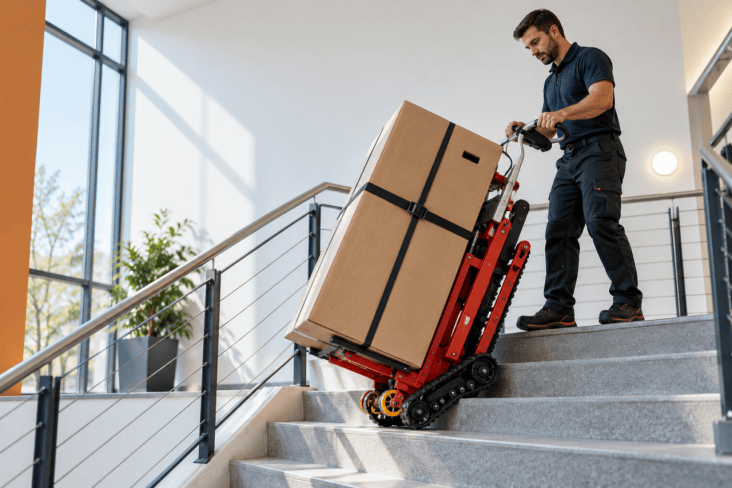
A stair climbing hand truck can help a crew avoid carrying the full load by hand through every step. Its value is greatest when that reduces repeated lifting and repositioning across a route that has been measured in advance. The team still has to secure the item, keep a clear path, control the transfer at both ends and follow the supplied operating method. A machine chosen only by its rated capacity may fail this practical test: a tall appliance may block the operator's view, a wide carton may not turn on a landing, and a fragile stair edge may need a different handling plan.
Consider the first transition. The load moves from level floor to the stair flight; its center of gravity changes relative to the operator and the contact points. At the top, the crew needs enough space to bring the machine back onto a level surface without setting the load in a doorway or blocking other people. A route survey should record tread depth, stair width, nosing, surface condition, landing dimensions, door openings and the final receiving position. These details turn a general product enquiry into a workable delivery plan.
The product earns its place in the workflow
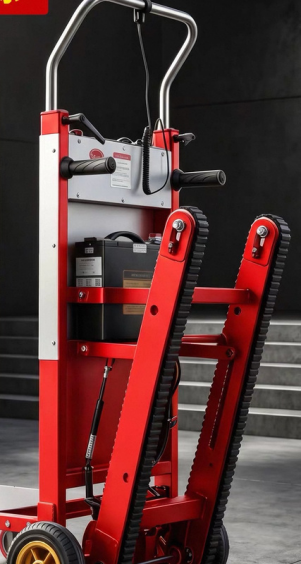
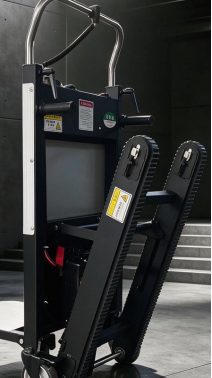
The catalog presents powered stair-handling variants for appliances and packaged goods. It distinguishes crawler and off-road versions, folding designs and models with auxiliary wheels. These are separate configuration choices rather than features to assume on every machine. The right question is which part of the journey creates the most difficulty. A crawler arrangement may suit one staircase; a longer level-floor approach may make a wheel-equipped variant more useful. Folding may matter when the crew must store the unit in a vehicle between stops. Each choice should be confirmed on the specific model before it becomes a purchasing claim.
The track and drive deserve particular attention because they meet the real staircase. A rubber track is described in the catalog, but it cannot promise that every step will remain unmarked or that every surface is suitable. A crew should review the condition of stone, timber, metal or tiled stairs, especially at the edges. The operator also needs a clear place to stand, a secure grip on the controls and an understood method for stopping or reversing. The current operating manual and, where the route is unusual, a practical demonstration are more useful than an attractive capacity headline.
The load interface matters just as much. A boxed appliance, a compact machine and a long packed component may weigh the same yet need different restraint and balance. Ask how the load is supported against the frame and secured during the climb. Check the complete weight, packaging, height and center of gravity, not just the product's nominal mass. If a fragile finish, projecting foot or loose accessory changes the balance, that detail should be addressed before the crew starts.
Three scenes that test a delivery plan
An appliance going to an upper floor
The route may begin at a van, continue across a lobby and end at a domestic staircase. A powered climbing machine can make the stair section more controlled, but the crew first needs to protect the appliance, verify its support and check the top landing. Where the item must be turned into a room, its packaging width may be more decisive than its weight. The efficiency gain is a smoother sequence with fewer unplanned set-downs, provided the route genuinely fits the machine and load.
Equipment moving into a service space
A service team may need to take a packaged unit to an upper plant room with no goods lift. Here the final doorway and the work area matter as much as the steps. Plan where the machine can be parked and where the load will transfer to another support. If the next task is positioning equipment at installation height, a separate installation lift may be needed. The stair climbing hand truck solves transport between levels; it does not complete the overhead installation.
Repeated multi-stop deliveries
For a crew making several stops, storage and level-floor movement become part of the selection. A folding configuration may fit a vehicle more easily; auxiliary wheels may help where corridors are long. Those potential advantages are useful only if the chosen model fits the vehicle, the load can be restrained and the crew has time to inspect the machine between jobs. Ask for the current folded dimensions, battery-care instructions and replacement-part information for the exact configuration being quoted.
A buying brief that starts with the route
Send ZGHELPLIFT photographs or a short video of the full route, not just the staircase. Include the load's complete weight, dimensions and underside, the stairs and landings, floor surfaces, door widths, the distance across level ground, the delivery vehicle, expected use frequency and destination country. Tell us whether storage space, auxiliary wheels or a folding frame is important. We can then discuss which current configuration deserves review and what the drawing and operating instructions still need to confirm.
When the load has reached its floor but still needs to be raised into position, continue with our Mast Installation Lift for HVAC Unit Positioning guide. The two machines address different stages of the same job.
Hello, friend! Just tell me what your requirements are for this product
and I will help you handle your purchase needs for it.